The sky was just beginning to soften with the pastel hues of early morning when I arrived in Poitiers, a city whose charm lies not only in its history but also in the way it gently unfolds itself to visitors. Poitiers, located in the west-central region of France, is a city that seems to pause between centuries. Its skyline is punctuated by Romanesque spires and medieval towers, its streets winding like thoughts through timeworn stone.
Even with just one day to explore, the city’s core offers an exceptional range of experiences—each step revealing layers of French, Roman, and early Christian heritage. What follows is a journey through five of Poitiers’ most iconic landmarks, traversed on foot, with a few lingering stops for contemplation, conversation, and the occasional pastry.
1. Church of Notre-Dame la Grande: A Jewel of Romanesque Art
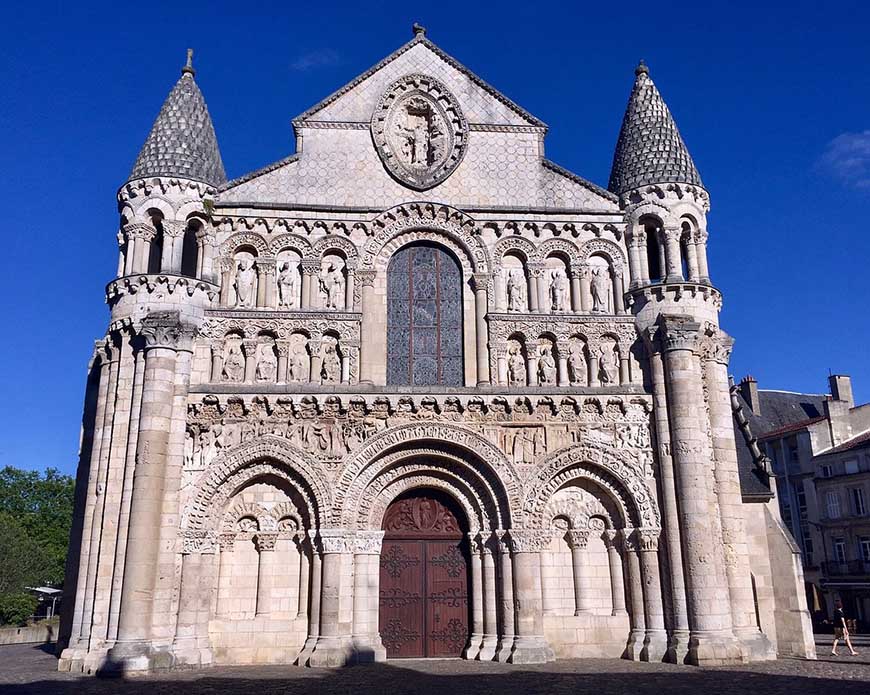
Standing before the Church of Notre-Dame la Grande is like encountering a page from a medieval manuscript rendered in stone. The façade, celebrated as one of the finest examples of Romanesque sculpture in France, is an intricate narrative of biblical scenes, saints, and symbolic creatures. It has the kind of symmetry that demands stillness.
The church sits quietly in the Place Charles-de-Gaulle, a modest square that takes on an almost sacred ambiance under the early morning light. Each detail on the façade feels purposeful, from the elongated figures of the apostles to the animals tucked beneath arches—some half-hidden, some glaring into the crowd as if waiting to be noticed. One could spend an hour just tracing the chisel marks, wondering how many lifetimes passed since their creation.
Inside, the transition is almost cinematic. Cool air wraps around stone columns that lift the gaze upward to the barrel vaults painted in subdued frescoes. Light pours in through stained glass windows in purples and blues, casting gentle reflections on the stone floor. The stillness is not mere silence—it’s the sound of history breathed in sacred rhythm.
A guide at the entrance, probably used to pilgrims and wide-eyed tourists, offered a whisper of a smile as I stood still before the high altar. She motioned to a corner niche where an 11th-century statue of the Virgin Mary rests. Delicately carved, it has witnessed prayers through wars, reforms, and revolutions. A few moments before that statue was enough to feel rooted—no matter how far from home.
At mid-morning, sunlight sharpens the church’s silhouette, making it a favorite among artists who gather with sketchpads in hand. I watched a young artist sitting on the edge of the fountain, sketching the rose window. She looked up only occasionally, trusting her hand to follow her memory.
2. Palace of the Counts of Poitou-Dukes of Aquitaine: Echoes of Eleanor
Leaving the quiet grace of Notre-Dame, a short walk leads to one of the city’s most historically charged landmarks: the Palace of the Counts of Poitou, also known as the Palace of the Dukes of Aquitaine. Tucked behind a rather unassuming façade lies one of the most remarkable remnants of medieval France.
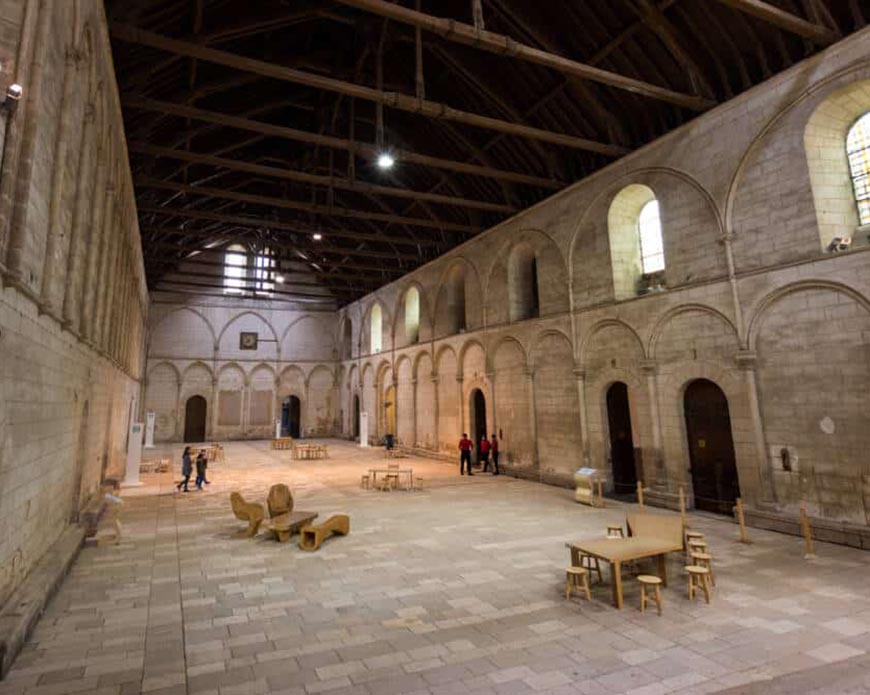
This was once the stronghold of Eleanor of Aquitaine, one of the most influential women in European history—queen of both France and England in her lifetime. Walking through the grand salle, the vast ceremonial hall with its rib-vaulted ceiling and open hearth, the magnitude of her influence resonates deeply. The hall is vast, lit now by tall windows that were once arrow slits, and the limestone walls bear the patina of centuries.
The hall itself, known as the “Salle des Pas Perdus” (Hall of Lost Footsteps), holds a name that couldn’t be more poetic. Each footfall echoes slightly in the cavernous space, a gentle reminder of the lords, ladies, judges, and poets who once passed here. There is no ornate gilding, no ostentatious decoration—just raw, commanding presence.
Down a narrow corridor is the Romanesque tower, accessible only by a spiral staircase that insists on a little patience and balance. From its windows, the rooftops of Poitiers stretch outward like a sea of orange and cream. One can see the line where the old city walls once stood. It’s not difficult to imagine Eleanor herself, standing watch as messengers arrived with news from faraway courts.
Outside, in the garden that now softens the palace’s rear view, I sat under a linden tree and imagined court poets performing chansons de geste before nobles dressed in velvet and fur. Even with the centuries removed, something of their breath seems to linger here, like old perfume on folded letters.
3. Baptistère Saint-Jean: The Oldest Christian Monument in France
Crossing over to Rue Jean-Jaurès brings the visitor to one of the city’s most quietly imposing structures: the Baptistère Saint-Jean. At first glance, it appears more like an outcrop of stone than a sacred space, squat and almost unimpressive from the outside. But stepping through its worn threshold is akin to time travel.
The building dates to the 4th century, making it one of the oldest Christian edifices in Western Europe. Its survival feels almost miraculous, considering the rise and fall of empires that surround its lifespan. Inside, the shadows play tricks. Light trickles in through high slit windows, painting soft bars across the mosaic floor.
Beneath the modern-day altar is an ancient baptismal font—a deep pool carved from stone where full-immersion baptisms were once conducted. Leaning over its edge, one can see the clear water resting still at the bottom, as if keeping centuries of whispered prayers.
The walls are sparse, the air slightly heavier with moisture and age. A few sarcophagi from the Merovingian period rest quietly in corners, their engravings nearly worn smooth. There is an absence of decoration here that feels deliberate, as if the early Christians who worshipped here sought closeness to God through simplicity, not splendor.
In the apse, faded frescoes depict saints and apostles in Byzantine poses—flat eyes staring ahead, fingers raised in silent blessing. A young boy, maybe eight years old, entered with his grandmother. She whispered stories to him in soft French, pointing to each figure with reverence. The boy listened intently, his eyes wide with that rare attention children lend to the truly ancient.
Outside, the sun had shifted its angle, casting long shadows from the stone columns along the perimeter. A street musician nearby played a haunting melody on the violin, just slow enough to match the weight of what stood behind me.
4. Cathédrale Saint-Pierre de Poitiers: The Gothic Counterpoint
From the intimate austerity of the baptistery, it’s a short walk uphill to the soaring lines of the Cathédrale Saint-Pierre. Its western façade looms into view gradually, a revelation rather than a presentation. Unlike Notre-Dame la Grande, which celebrates the Romanesque style, Saint-Pierre is a high Gothic masterpiece—more vertical, more pointed, more ambitious.
The cathedral was commissioned by Henry II of England and Eleanor of Aquitaine in the 12th century, and it bears their mark both literally and architecturally. The rose window is its most immediate spectacle, a glorious burst of color and form that bathes the nave in kaleidoscopic light when the sun hits just right.
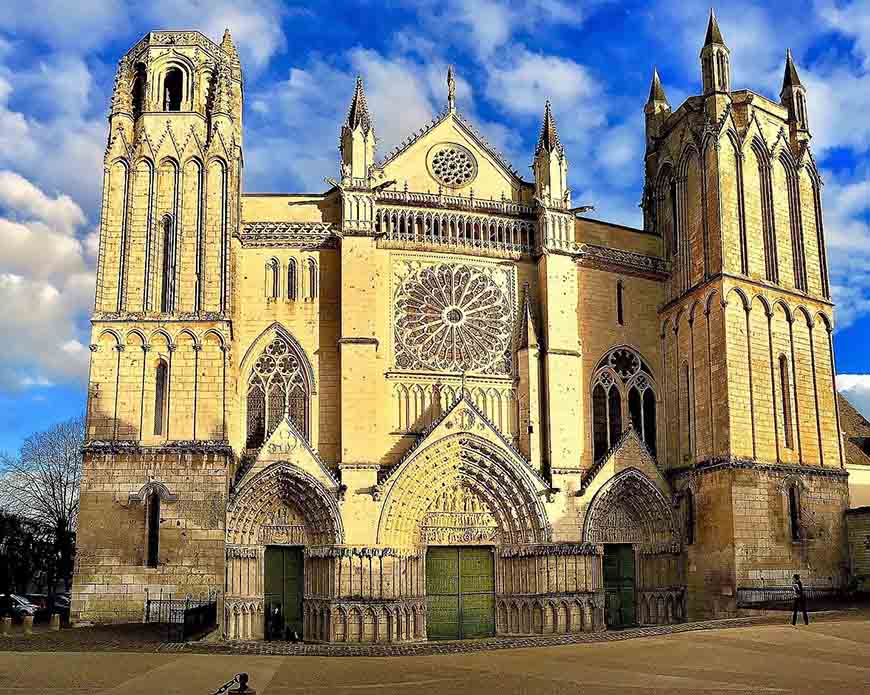
Entering the cathedral, the eye naturally climbs—the ribbed vaults soar far overhead, drawing attention to the interplay of structure and spirituality. The organ, an impressive 18th-century addition, stands like a gilded sentinel above the entrance. I waited as a short recital began, the chords swelling to fill every corner of the cavernous interior. The acoustics gave each note a purity that felt cleansing.
The chapels lining the aisles each offer their own focus. One contains an intricately carved wooden choir stall, another an altar dedicated to Saint Radegonde. A long brass line, the meridian, cuts through the transept floor, once used to track solstices through a pinhole in the southern wall. This fusion of faith and science whispers of a time when the heavens were consulted both for prayer and navigation.
In a quiet side chapel, I found a votive stand flickering with candles. A woman in a black coat stood still, not praying so much as listening. The air here was heavy with wax and hope.
When I stepped back into the light, the square before the cathedral was buzzing. Children ran across the stones, their laughter momentarily louder than the bells above. It felt right.
5. Parc de Blossac: A Stroll Through 18th-Century Elegance
As the afternoon softened into gold, I made my way to the Parc de Blossac, an 18th-century garden that offers a graceful respite from stone and shadow. Sprawling across several hectares, the park was commissioned during the Enlightenment and retains its geometric precision—alleys lined with lime trees, sculpted fountains, and an ornamental terrace that opens onto the Clain River.
There is something calming in the park’s symmetry. Locals walked their dogs along gravel paths, old men played pétanque beneath the chestnuts, and children zipped past on scooters, leaving trails of laughter. I paused near the ornamental pond where ducks and swans glided past, utterly unconcerned with the human century.
A wrought-iron fence surrounds the park, offering an embrace rather than a boundary. In one corner, a small theatre pavilion stands closed for the season, its painted panels hinting at summer performances to come. A gardener in a straw hat pruned rosebushes with quiet devotion.
Beneath a pergola covered in vines, I opened a paper bag containing a still-warm chausson aux pommes from a nearby bakery. The pastry flaked perfectly, each bite releasing a sweetness that matched the golden hour. The bells of Saint-Hilaire rang in the distance, their sound softened by distance and wind.
There is a bench in the southern corner of the park, facing the rooftops of the lower town. From there, the city’s ancient skyline reveals itself once more—spires and domes, tiled rooftops, and the occasional flutter of a pigeon in flight. It was here that I sat longest, letting time drift with the shadows.
Poitiers doesn’t rush you. It never has. This is a city that asks for attention but rewards it quietly. Its grandeur is whispered, not shouted; its beauty grows the more you walk, look, and listen. The streets still curve where Roman chariots once passed, the bells still ring for hours marked long before wristwatches, and the walls still breathe of lives lived well and long.